|
Att läsa
stift
... eller konsten att
välja huvudmunstycke med hjälp av "plug chop"-metoden
-
Sätt i nytt/nya
stift
-
Värm upp motorn
-
Leta reda på en lång raksträcka
- lätt uppförslut
gör inget - och kör på fullt skaft på hög växel 20-30 sek
-
Håll kvar fullgas samtidigt som du frikopplar och trycker in dödarknappen
-
Rulla till stopp,
montera ur
stiftet och
läs av.
Hur läser man av?
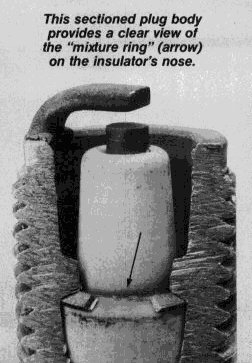
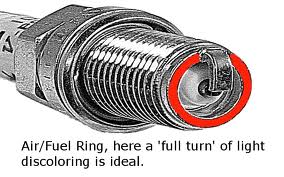
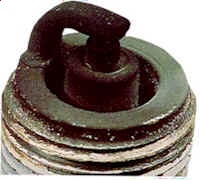
Vad som intresserar oss är färgen på ringen runt stiftet, alltså den del av
gängan som står i kontakt med förbränningsrummet.
Även
porslinet längst ner vid centrumelektrodens fot säger oss en del men detta är
svårare att upptäcka utan att såga itu stiftet.
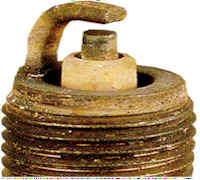
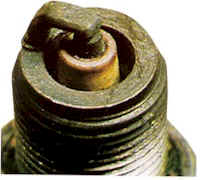
Om metallen runt
stiftet uppvisar en ljus, chokladbrun färg visar detta att vi har valt rätt huvudmunstycket.
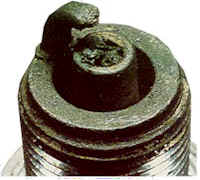
En kritvit ring
runt stiftet - eller ingen färg alls - indikerar för litet huvudumunstycke.
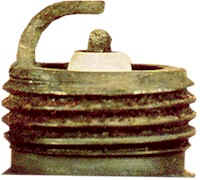
Har stiftets
ytterring en sotig, torr, svart beläggning - och/eller om färgen på porslinet
når längre upp än 3 mm från botten - är huvudmunstycket
för stort.
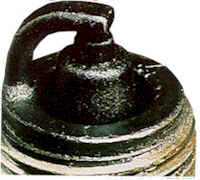
Om stiftet däremot
är svart och fuktigt är orsaken snarare att olja letat sig in i förbränningsrummet. Detta kan bero på
läckande ventilstyrningar och otäta kolvringar (fyrtakt) eller läckande packning mellan trans/växellåda och vevhus (tvåtakt).
| Normal |
 |
| Combustion deposits are
slight and not heavy enough to cause any detrimental effect on engine
performance. Note the brown to greyish tan color, and minimal amount of
electrode erosion which clearly indicates the plug is in the correct
heat range and has been operating in a "healthy" engine. |
|
| Mechanical Damage |
 |
| May be caused by a foreign
object that has accidentally entered the combustion chamber. When this
condition is discovered, check the other cylinders to prevent a
recurrence, since it is possible for a small object to "travel" from one
cylinder to another where a large degree of valve overlap exists. This
condition may also be due to improper reach spark plugs that permit the
piston to touch or collide with the firing end. |
|
| Oil Fouled |
 |
| Too much oil is entering
the combustion chamber. This is often caused by piston rings or cylinder
walls that are badly worn. Oil may also be pulled into the chamber
because of excessive clearance in the valve stem guides. If the PCV
valve is plugged or inoperative it can cause a build-up of crankcase
pressure which can force oil and oil vapors past the rings and valve
guides into the combustion chamber. |
|
| Overheated |
 |
| A clean, white insulator
firing tip and/or excessive electrode erosion indicates this spark plug
condition. k This is often caused by over advanced ignition, timing,
poor engine cooling system efficiency (scale, stoppages, low level), a
very lean air/fuel mixture, or a leaking intake manifold. When these
conditions prevail, even a plug of the correct heat range will overheat. |
|
| Insulator Glazing |
 |
| Glazing appears as a
yellowish, varnish-like color. This condition indicates that spark plug
temperatures have risen suddenly during a hard, fast acceleration
period. As a result, normal combustion deposits do not have an
opportunity to "fluff-off" as they normally do. Instead, they melt to
form a conductive coating and misfire will occur. |
|
| Pre-Ignition |
 |
| Usually one or a
combination of several engine operating conditions are the prime causes
of pre-ignition. It may originate from glowing combustion chamber
deposits, hot spots in the combustion chamber due to poor control of
engine heat, cross-firing (electrical induction between spark plug
wires), or the plug heat range is too high for the engine or its
operating conditions. |
|
| Gap Bridging |
 |
| Rarely occurs in automotive
engines, however, this condition is caused by similar conditions that
produce splash fouling. Combustion deposits thrown loose may lodge
between the electrodes, causing a dead short and misfire. Fluffy
materials that accumulate on the side electrode may melt to bridge the
gap when the engine is suddenly put under a heavy load. |
|
| Splash Fouled |
 |
| Appears as "spotted"
deposits on the firing tip of the insulator and often occurs after a
long delayed tune-up. By-products of combustion may loosen suddenly when
normal combustion temperatures are restored. During hard acceleration
these materials shed from the piston crown or valve heads, and are
thrown against the hot insulator surface. |
|
| Detonation |
 |
| This form of abnormal
combustion has fractured the insulator core nose of the plug. The
explosion that occurs in this situation apples extreme pressures on
internal engine components. Prime causes include ignition time advanced
too far, lean air/fuel mixtures, and insufficient octane rating of the
gasoline. |
|
| Ash Fouled |
 |
| A build-up of combustion
deposits stemming primarily from the burning of oil and/or fuel
additives during normal combustion ... normally non-conductive. When
heavier deposits are allowed to accumulate over a longer mileage period,
they can "mask" the spark, resulting in a plug misfire condition. |
|
| Carbon Fouled |
 |
Soft, black, sooty deposits
easily identify this plug condition. This is most often caused by an
over-rich, air/fuel mixture.
Check for a sticking choke, clogged air cleaner, or a carburetor problem
- float level high, defective needle or seat, etc.
This may also be attributed to weak ignition voltage, an inoperative
preheating system (carburetor intake air), or extremely low cylinder
compression. |
|
| Worn |
 |
| This plug has served its
useful life and should be replaced. The voltage required to fire the
plug has approximately doubled and will continue to increase with
additional miles of travel. Even higher voltage requirements, as much as
100% above normal, may occur when the engine is quickly accelerated.
Poor engine performance and a loss in fuel economy are traits of a worn
spark |
|
SOURCE: Champion Spark Plugs
Har du lätt
för engelska kan du läsa mer
här!
|